Storytelling

Last fall, I promised to do a series of posts on cognitive biases. A cognitive bias, in case you’re not familiar with the term, is a kind of built-in mental shortcut that we take when making decisions. Usually, we’re not aware we’re doing it.

Here’s a classic example, the framing bias: You’re sitting in front of a bunch of potential investors. What do you tell them – A: that your product has a 1 in 10 chance of succeeding, or B: that it has a 90% chance of failure?  Doh. 

Here’s another, the anchoring bias. You’re in a store. Everything on the rack is over $200. You see a sweater for $50. What a good deal! Now you’re in another store. Everything on the rack is under $50. You see the exact same sweater, for $50. Not such a good deal after all?

I’ve been doing a bit of reading on the subject, and it turns out we’re brimming with biases. We think we’re rational, that we can look objectively at a situation or listen to someone and weigh his or her words impartially, but we can’t. We’re highly illogical creatures bound up in a complex net of emotion and suggestion, living under the illusion that our brains work like computers.

It’s so bad that I’ve totally lost my desire to write about it. If you’d like to get depressed, too, here’s a short reading list:

Part of my disgust stems from my observation that the current political charade that is going on in the US, otherwise known as the Republican Primaries, is a stunning and vivid example of how to exploit most of these biases. Biases like the exposure effect, in which you tend to increasingly prefer something when you are repeatedly exposed to it (like a face or a slogan), and the illusion-of-truth effect, in which you are more likely to believe a statement is true if you have heard it before – whether or not it really is true. That the machine so blatantly exploits our cognitive weaknesses should perhaps not come as a surprise, but I still find it deeply disappointing and disturbing.

Perhaps the most interesting thing I’ve taken away from all this reading is that humans have an innate need to tell a story. We may vary somewhat in our tendency to make irrational decisions, to act on instincts that lie far beneath the surface of our consciousness, but the one thing we all have in common is our need to create a narrative that ties it all together. We do something or make a choice, and then we make up a story to explain why we did the thing or made the choice. Experiment after experiment has shown this to be the case. That’s what most of the billions of neurons inside those big brains of ours are doing: making up stories to rationalize our knee-jerk reactions.

We’re storytelling machines.

I think it’s high time we stopped settling for fairy tales, where everything is nice and simple – good versus evil, rags-to-riches, a stranger came to town – and started insisting on stories that reflect the real complexity of the world we live in. Then I think we might actually have a fighting chance of making decisions that would benefit us and our children in the long run.

Here’s a snippet from a TED talk on the subject by Tyler Cowen. I highly recommend you watch the talk or read the transcript. And then think about the political landscape. Then pass the Prozac.

One interesting thing about cognitive biases – they’re the subject of so many books these days. There’s the Nudge book, the Sway book, the Blink book, like the one-title book, all about the ways in which we screw up. And there are so many ways, but what I find interesting is that none of these books identify what, to me, is the single, central, most important way we screw up, and that is, we tell ourselves too many stories, or we are too easily seduced by stories.

So what are the problems of relying too heavily on stories? You view your life like “this” instead of the mess that it is or it ought to be. But more specifically, I think of a few major problems when we think too much in terms of narrative. First, narratives tend to be too simple. The point of a narrative is to strip it way, not just into 18 minutes, but most narratives you could present in a sentence or two. So when you strip away detail, you tend to tell stories in terms of good vs. evil, whether it’s a story about your own life or a story about politics. Now, some things actually are good vs. evil. We all know this, right? But I think, as a general rule, we’re too inclined to tell the good vs. evil story. As a simple rule of thumb, just imagine every time you’re telling a good vs. evil story, you’re basically lowering your IQ by ten points or more. If you just adopt that as a kind of inner mental habit, it’s, in my view, one way to get a lot smarter pretty quickly. You don’t have to read any books. Just imagine yourself pressing a button every time you tell the good vs. evil story, and by pressing that button you’re lowering your IQ by ten points or more.[…]

If the presidential candidates followed this rule, lowering their IQ by 10 points every time they told a good versus evil story, they’d be brain dead by now. Wait. They are! Welcome to the world of zombie politics.

I saw a video the other day on YouTube, classic Newt Gingrich blasting Mick Romney. You know what he saves for last? The ultimate thing that should slam Romney into the ground, make him a laughing stock, un-electable? Hint: he shares it with John Kerry.

You’ll have to see it to believe it.

Now, enough depressing stuff. Here’s the good news: Somehow I got through the quality control filter and snagged a spot in Friday’s TEDx Lausanne audience!  I’m particularly looking forward to a talk by Steve Edge, who describes himself as “Designer, branding guru, dyslexic and madman.” More on that next week.

Image: wingedwolf

Conversions

No, this isn’t a religious post. It’s not about converting tablespoons of butter into grams, or pounds into kilograms.  It’s not even about the conversions between dollars and Swiss francs I made (somewhat gleefully) in my head as I turned my credit card over time and again during our trip to Santa Fe over the Christmas holidays.

No, this is about skiing.

Last Sunday I did my first back-country ski outing of the year. Correction: my first back-country ski outing since winter 2005, when Marc’s parents were here for two months and we could do whatever we wanted on the weekends without worrying about being bad parents.

We were going to go back-country skiing last year, except it didn’t snow. The year before that, we rented an apartment in a ski area for the season, and went there on the weekends instead. The year before that, well, I don’t remember. It can’t have been that memorable. Now the babies definitely don’t need sitting anymore. What’s more, they have strong opinions on how they want to spend their weekend mornings (such as sleeping), and these plans usually don’t involve us. We’re once more free to head to the mountains.

Maybe I’m getting grumpy in my old age, but I find that ski lifts, crowds, music blaring from loudspeakers on ski parks, decks of sunbathers drinking alcohol at 3,000 meters, and – did I mention it? — crowds – just make me grumpier. Any time school’s out in Switzerland, the entire country goes skiing. The slopes are packed with people moving at high speeds. The red-and-white helicopters are busy buzzing back and forth transporting accident victims to hospitals in the valleys below. The autoroutes get backed up for miles. Thanks, but no thanks.  The only kind of skiing I’m interested in doing now involves strapping skins on my skis, shouldering a backpack containing a bar of chocolate, a thermos of hot tea and warm mittens, and heading for a mountain.

You just don’t get this kind of solitude and awesomeness in a ski area.

It’s pretty stupid to go traipsing around in the “back country” on skis, though, unless you know what you’re doing.  Every weekend, people who go off-piste in the Alps end up buried in avalanches — even people who are accompanied by mountain guides.  Not only am I not quite ready to die yet (the novel isn’t done), but I also don’t want some poor hiker to come across my rotting corpse in June when the snow starts melting. (It does happen).

So, since Marc and I definitely don’t know what we’re doing, we did the only sensible thing and turned to the pros. We joined the local chapter of the Swiss Alpine Club. We took an avalanche course. We learned to “read” the layers of snow, we dug endless avalanche beacons out of snowdrifts, we practiced shoveling at high speed with little metal shovels, and we learned to climb up mountains on our skis and ski down through all manner of different kinds of snow. We also toured a cheese-making place. I bet you don’t get that in US avalanche courses.

To climb up a mountain on skis, you have to do switchbacks. You cut along the slope for a while, then you turn and go the other direction, in a complicated ballet-like maneuver called a “kick-turn,” or, in French, a conversion.

Several years ago, I had mastered the conversion. You turn the uphill foot about 130 degrees (think 4th position in ballet), then lean forward into the slope and lift the back ski up, kicking the tip in around the ankle of the planted foot and sliding the ski alongside its mate. Here’s a picture of someone doing one:

In this photo the person hasn’t yet swung the right ski up alongside the left ski, which is planted. Depending on the steepness of the hill and the snow conditions, this exercise can be seriously nervewracking.

Sunday’s Alpine Club outing was rated F for Facile (easy), so the hill wasn’t steep. The snow was nice and deep and powdery. No problem getting a good foot plant in it. I was enthusiastic, third in the line of 9 people climbing up the slope.

Wow! This feels good!

Did I mention that the critical thing about the conversion is that you need to lean into the hill?

Everything went fine until I forgot that.

I swung my uphill ski 130 degrees around, up the zigzag. Then I put my weight on it and lifted the back ski off the ground.

Two seconds later, I lost my balance and promptly fell backwards down the hill. Everyone was watching me. Now when your head is down the hill and your skis are up on the slope above you, you’ve got to do some maneuvering to get things sorted out. I had to wait for all of them to climb past me to get myself upright again.

Merde! I cursed, humiliated in the extreme. My face was hot and I felt the suspicious prick of tears behind my eyes. I avoided looking at anyone as they skied past. I just knew they were all laughing at me.

All of them, that is, except one very nice guy called Alex, who very gently and calmly said he was going to show me how to do a conversion. Which he did, emphasizing the leaning into the hill part. I practiced a couple of times and felt a little less like I wanted the earth to open up and swallow me up.

It was a good idea to practice. It’s one thing to mess up your conversion on a gentle slope in cushy powder. It’s another to mess up on a steep slope with a pile of rocks down below. A little humble pie is preferable to brains splattered on rocks, any day.

We kept climbing. The higher we got, the harder the wind blew. It started spitting snow. Genevieve, a 70-year-old energy bomb of a woman just in front of me, was struggling and had to stop and breathe hard several times. At the top, the wind was whipping the snow up into our faces and we could hardly see a thing. Nevertheless, we engaged in the Swiss kissing ritual. Kiss, kiss, kiss, – it must have been at least -10 C with the wind chill, and as each person arrived, he or she had to make the rounds. I admit I air-kissed a few. My fingers turned numb as I took the skins off my skis and tried (not very successfully) to attach them to their paper backing. Oh, so this is why you’re supposed to use the plastic backing and not the paper one, I realized. Man, I really am out of practice.

Alex seemed totally unfazed by the weather and went around offering everyone a dried fig.

Our leader wisely counseled us to keep each other in view during the descent. This is why you go with the Alpine Club, I thought, as we blindly followed him down the slope. They know what they’re doing. For all I knew, he could have been leading us off a cliff. On the positive side, I only fell once and I don’t think anyone saw it.

At one point we had all stopped together and there were two skiers still above us. Everybody watch Rita, said the leader. Rita, a little round gnome-like person in a purple parka and a pink knitted hat with a pom-pom on top, didn’t really look like an athlete. Once she turned her skis down the hill, though, all that changed.  She just kind of floated effortlessly back and forth down the slope. It truly was a thing of beauty. The rest of us were more or less making our way down the mountain – Rita, she skied.

Once we were out of the worst of the wind, the leader found a spot under a tree to eat our lunch. No kidding. Apparently, part of the definition of an outing is that you have to stop for lunch. I think it’s part of the Alpine Club charter. I took advantage of the opportunity to try and get technique tips from Rita.

Genevieve was too exhausted to eat anything. Maybe she shouldn’t have skied the entire previous day and then come on the outing as well. Getting old is the pits, she informed me.

An hour or so later, we were heading back to Lausanne, after a stop in a bistro for hot chocolate and mulled wine on the way (that’s also part of the definition of an outing). Nobody mentioned my humiliation. When they asked what I did, I told them I was a writer. Writing a novel.

Wow, I thought to myself as the words came out. If I’m saying it out loud, I guess it must really be true.

Yet another kind of conversion. 2012 is starting out very auspiciously!

Photos: CAS Morges


Epiphanies

It’s January 6th, epiphany. This is the day the three kings apparently saw baby Jesus for the first time. Epiphany comes from the Greek word epiphaneia, “appearance” or “manifestation.” The Greeks were referring to things like the appearance of the sun on the horizon at dawn, an enemy, or a god.

When the word “epiphany” is used in English today, it usually refers to an idea or an unusually profound insight. I’ve had an epiphany! Marc exclaims. Maybe my stomach hurt because I had two apples, five kiwis and four cups of coffee before heading out for my run today! (actually, in all fairness, he probably wouldn’t have said epiphany. He’d probably just say I just thought of something. And I’d reply, Did it hurt?  And then he’d tell me about his gastric situation and I’d say, well, doh, what did you expect?)

That an epiphany can be both the physical manifestation of something or someone as well as a purely cerebral manifestation of insight – a light bulb going off in your head – is an oddly apt illustration for our times, in which the boundaries between the virtual and the physical worlds seem to be increasingly hard to pin down.

Oh, I see. What an epiphany.

One current buzz phrase is “augmented reality” – if you’re interested, my friend the Spime Wrangler writes about the topic beautifully on her blog. It means that we infuse extra layers of meaning onto objects in the physical world. But what, really, is reality? We already experience the physical world through the filter of our oh-so-fallible senses. Add some Bailey’s, and my reality is definitely augmented, and in a good way. Come to think of it, does it make any sense at all to even talk about “reality” as such?

Over the holidays, on that long trans-Atlantic flight, I finally got a chance to read Incognito by David Eagleman, the one I told you was on the top of my list back in June when I wrote a post about inspiration. Here’s the thing. Reality, augmented or just garden-variety, is a construct. Seeing has very little to do with our eyes and everything to do with our brains, which are masters of taking what they can get and creating out of it a world in which we can survive. Eagleman uses the example of a man who has been blind most of his life. He has an operation that restores his vision. But his brain doesn’t know how to interpret the incoming data. None of it makes any sense to him. He can see, but he can’t “see.”

He gazed with utter puzzlement at the objects in front of him. His brain didn’t know what to make of the barrage of inputs. He wasn’t experiencing his sons’ faces; he was experiencing only un-interpretable sensations of edges and colors and lights. Although his eyes were functioning, he didn’t have vision. […] The strange electrical storms inside the pitch-black skull get turned into conscious summaries after a long haul of figuring out how objects in the world match up across the senses. Consider the experience of walking down a hallway. Mike knew from a lifetime of moving down corridors that walls remain parallel, at arm’s length, the whole way down. So when his vision was restored, the concept of converging perspective lines was beyond his capacity to understand. It made no sense to his brain.

Talk about feeling sea-sick! The amazing thing about this is that it took Mike’s brain only a few weeks to adapt. Now he sees just like you and I do.

Eagleman uses another example, this time a blind rock climber named Eric Weihenmayer, who in 2001 became the first blind person to climb Mount Everest. He “sees” using a grid of electrodes in his mouth, a device called a BrainPort.

Although the tongue is normally a taste organ, its moisture and chemical environment make it an excellent brain-machine interface when a tingling electrode grid is laid on its surface. The grid translates a video input into patters of electrical pulses, allowing the tongue to discern qualities usually ascribed to vision, such as distance, shape, direction of movement and size. The apparatus reminds us that we see not with our eyes but rather with our brains.

This kind of rocked my boat, particularly when Eagleman went on to reveal that the BrainPort is also being used to feed infrared or sonar input to the tongue so that divers can see in murky water of soldiers can have 360-degree vision. Eyes in the back of your head, indeed. Just one page later, I had to put the book down so my brain wouldn’t overheat. Here’s why:

In the future we may be able to plug new sorts of data streams directly into the brain, such as infrared or ultraviolet vision, or even weather data or stock market data. The brain will struggle to absorb the data at first, but eventually it will learn to speak the language. We’ll be able to add new functionality and roll out Brain 2.0. […] this is not a theoretical notion; it already exists in various guises.

Now why anyone would want stock market data plugged directly into their brains is beyond me, but I know Marc would love a direct feed from ESPN.

That’s probably enough to chew on for one day. This wide, wonderful world is already amazing, even with the limited sensory apparatus we’re born with. Just thinking about what more might be out there – the rich smell and sound experience of the dog, the razor-sharp vision of the eagle, the reverberating echoes of the bat – well, it’s tempting, isn’t it? But remember that just because a data stream can be piped in, that doesn’t mean our brains will know what to do with it. That five-pound lump between our shoulders is notoriously fallible when it comes to decision-making and rationalizing.

So here’s the epiphany of the day: Be like the Greeks. Watch a sunset. Watch your enemy approach over a far-off hill. See the face of the gods in the clouds outside an airplane window.  And when the light bulb of ephiphany goes off in your brain, remember that your brain is a fallible organ, eager to create meaning from nothingness, and bask in the wonder of it all.

Lightbulb image: Shuttermonkey

Out with a bang

fireworksHappy New Year, everyone. Looks like the world made it through another revolution around the Sun, despite Harold Camping’s careful calculations.

I have it on good faith, however, that it really is going to end in 2012. Yes, it’s more eschatological stuff, this time from the “Mesoamerican Long Count Calendar” (e.g. the Mayans). So set your clocks for December 21, 2012, and get all your unfinished business out of the way by then. I know I’m going to finish this novel and to hell with everything else. Taxes, schmaxes. What a colossal waste of time.

One thing I might do to get ready is memorize the Scrabble dictionary. If I end up in heaven with a lot of time on my hands, I don’t want to be at a disadvantage like I was this Christmas. On the other hand, that would be a pretty convincing version of hell — being in an endless Scrabble game with three other people who know every single esoteric word in the Scrabble dictionary. Of course ‘ka’ is a word! Isn’t it just too bad that it blocked you from putting ‘quiz’ on the triple word score…

I think I’ll play it safe and do the memorizing.

Looking back at 2011, I’d have to say it was a watershed year. Here are some highlights:

  • I started the Gydle publishing empire. I have written more original words this year than ever before in my life.
  • My world was rocked when I figured out that we are being crowdsourced by bacteria. I certainly hope yours was, too.
  • My bare feet discovered that the ground is a surface that can bite back.
  • I finally gave myself permission to live my lifelong dream – (the novel).
  • I learned that I’m not 25 anymore thanks to a surprise sucker punch from a blood pressure monitor.
  • I finally broke my jelly belly addiction. I may have to change the banner on the blog. Sugar snap peas? Carrots?

What about you? What did you do in those precious months after May 21, when the world was supposed to end? I certainly hope you made the most of it.

In the meantime, since I’m clearly too late for any preventive measures, before you go to bed tonight, take a vitamin B supplement and an advil. It might help with tomorrow’s hangover, according to a press release from the Loyola University Medical System.

And if the world is spinning because you drank too much? Here’s why.

On a final note in this final hour of the penultimate year of human existence, I’d like to thank all of you for coming here. Thanks for your attention and support. Thanks for your comments, your suggestions, your ideas. Thanks for making all my efforts so very worthwhile. Thanks for joining me in my many-flavored world and for making it so much more interesting!

See you in 2012!
Photo Credit: sunsurfr via Compfight cc

Late-night thoughts on holiday travel

New Mexico is in the midst of a major winter storm, with snowpacked, icy roads all over the place, gusty winds, the whole shebang. And my family is up in it in a flimsy tube of steel. Continue reading →

Fold It!

As I stand in the Lausanne train station holding a sign saying “Marcel,” the volume of passengers from platform 8 dwindles from a steady flow to a trickle to a stop. He probably exited the other end of the platform. I stay put like you’re supposed to when you’re lost. He was the 20-something computer geek. I’d let him find me.

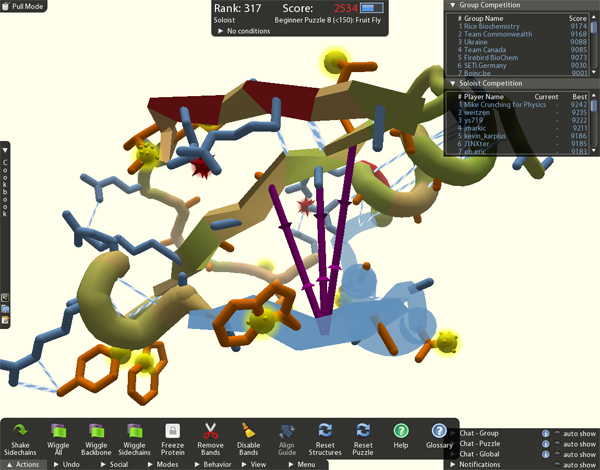
Sure enough, a few minutes later, he does. This amiable, t-shirt-clad student has come all the way from Zurich after his 8:00 class at ETH to show me how to play a protein folding game called FoldIt. The IT dude in my novel is a player, so I have to learn it, too.

In EPFL’s Rolex Learning Center a half hour later, we quickly download the game onto my Macbook, since his HP is bugging, and he logs into his account. A list of protein puzzles appears, with names like quick fix the loop puzzle, New Player Puzzle: Pollen Allergen Protein, Quick Flu Design Puzzle 3, Symmetric Foldon Puzzle 1. Underneath each puzzle is a brief description. Here’s one:

Foldon is a small, 27 residue domain from the C-terminus of a phage virus protein called fibritin. Your job is to fold 3 chains into a larger trimeric domain that includes foldon. You’ll be allowed to move foldon around as well, but you can only mutate the residues in the polyalanine extension. And remember, three-fold symmetry will be enforced! If you are new to Foldit, make sure you have completed Intro Puzzle 5-2, & 7-1 through 7-4. More details in the blog.

Holy crap, what am I getting into? I think. But Marcel dives right in and puts the flu design protein up on the screen. The backbone, he explains as he twists the protein around, is made of amino acids, arranged in macaroni-like helixes, flat sheets and sausagey loops. Poking out from it are key-like side chains, the blue ones hydrophilic, or water-loving, and orange ones hydrophobic.


He shows me how to zoom and twist the protein around, how to put purple rubber band-like things onto various arms of it and pull it together or stretch it apart, how to change a loop to a helix to a sheet, and how to freeze one bit and tweak another. Hydrogen bonds, which look like blue-and-white barbershop poles, like to form between sheets and along helixes, he explains, showing me how to line them up.

Angry red bombs appear when things get squashed too tightly together – clashes. Big, pulsing red blobs appear when there’s too much empty space – voids. You want to avoid those. We fiddle with the side chains, rotating the orange ones in and the blue ones out. He even shows me how to “mutate” them.

The whole time, he’s keeping one eye on the score that’s evolving in the upper part of the screen. He makes a move that results in a huge loss of points; our score plunges into the negative numbers, turns red, and lots of red bombs appear. “Quick! Put it back!” I panic.

“Hang on,” he laughs. He’s totally relaxed. “Now we’re going to wiggle and shake.” He clicks a button and the whole structure starts bouncing, complete with a ticking soundtrack in the background. I watch as the points move rapidly upwards out of the red, then gradually slow down, while still increasing. After a while, Marcel clicks the wiggle off. Our total is higher than it was before!  Then he clicks another button and all the side chains start rotating. Once again, the score ticks upwards. We sit back, satisfied.

The points represent energy, he explains. The native structure of the protein is going to be its lowest energy state. The higher the number of points, the lower the energy state. But like a ball on a golf course, you can get stuck in a local minimum and miss the hole you’re shooting for. “It’s like this building,” he says, looking at the undulating floor of the Learning Center. “A ball will roll down into a hole. But that doesn’t mean it’s the lowest hole around. It’s just the one it was nearest.” Sometimes you have to pull back quite a ways and shake things up to get the ball to roll into a deeper hole – a lower energy state.

When a protein is manufactured in the cell, it zips into this native shape in no time flat. The shape is critical to the protein’s function. Sometimes, if the environment isn’t right or there’s a problem with an accompanying protein, called a chaperone, the folding doesn’t go right. Misfolded proteins are implicated in a variety of diseases like mad cow, Alzheimer’s, Parkinson’s and cystic fibrosis.

Scientists would dearly like to be able to predict the structure of proteins, because then they could design drugs that could fix the misfolded ones, or disable the harmful ones in viruses or bacteria. With this kind of knowledge, perhaps some day new proteins could be engineered for gene therapy or other medical miracles.

Algorithms to predict structure chug along on huge servers or in distributed computing networks, like rosetta@home, which uses spare CPU on home computers to run its calculations, but they take forever because they have to brute force every conceivable possible convolution. There’s no guarantee the algorithm will find the lowest energy state, either, even after all that calculating. It’s a really complicated problem. FoldIt taps into something these algorithms cannot – human intuition and pattern-finding capabilities.

Marcel shows me the different puzzles available – they range in difficulty from easy structures put up for newbies like me to complex proteins involved in actual scientific research. There are only a few on at a time, each one with an open window of about a week, in which players work either on their own or in teams to get the highest possible points before it “closes.” You can “evolve” a protein, which means you work on a solution, and then share it with other people, who then add their bit to it, and so on. The protein’s structure then progresses as a joint effort. You have two rankings – “solo” and “team,” based on your results in each category. Marcel is a member of the Androids team.

He estimates that there are about 300 really active players, spread all over the world. The master solo player is a guy from Slovenia called Wudoo.  A woman in Texas with a couple of kids, jpilkington, is the “evolver queen,” he tells me in reverent tones. While we’re playing, she comes online and starts chatting with other players. I tell her my brain is exploding. “LOL,” she replies.

Rav3n_pl, a programmer who lives in Poland, is a master at writing “scripts” –recipes that apply long strings of commands to the protein, which can be run in the background for hours while you’re off doing something else. Marcel started the flu design puzzle that morning. He first did a few manual tweaks, and then ran one of Rav3n_pl’s genetic algorithm scripts while he took a shower and ate breakfast. “The manual stuff can only take you so far,” he explains. After that, you eke out points at a time by running scripts. (These recipes, BTW, are the subject of a recent article in PNAS.)

As we continue to work the protein, I see what he means. The score appears to be stuck. “The deeper you are in an energy hole, the harder it is to move something,” he says.  He opens the “cookbook” he has set up on the left hand side of the window and starts a script. We watch the protein jiggle and shake, the points fluctuating wildly as it starts, stops, reverts and starts another iteration.

Finding your way out of the hole is an art. There are a few people who are consistently among the top scorers, he tells me. “It’s not just luck. There’s something – either they have an intuitive feel for how the programming works, or they see patterns, or maybe they just have good computers and can run tons of scripts.”

Marcel has been away for a couple of weeks on military duty. Even so, his overall rank is 61. Wow, I say, you must play all the time!

“No, not more than an hour or two a day, max,” he assures me. “And a lot of that is just scripts running.” He admits, though, that when a deadline is approaching, he might put more time in with his team.

Well, sure, but you must also know a ton about molecular biology, in order to be able to rack up a ranking that high?

“Nope,” he says. “I just like getting the points. Sometimes you make a move, and you get a few points, and the protein just looks right, and it’s an amazing feeling.”

He also likes the social aspect of the game. “I’d never just play it offline,” he says. “I like chatting with my teammates. What should be the next step? What’s going on in their lives?” True. He is a chatty guy. He’s spending the entire afternoon with me, an uber-noob novelist, after all.

I figure he got into the game because he’s a chemistry student. “Not really,” he tells me. “At first, I looked into the seti@home thing, but then, really, who cares about aliens? I found rosetta@home, and that was cool, proteins are important, and it was there that I found out about FoldIt.”

Finally, we open the most recent puzzle on the site, something called a CASP roll, a “freestyle” protein with 197 amino acids that has to be folded from scratch. Sometime in February, the best FoldIt solutions will be compared with solutions cranked out by algorithms running on servers and with experimental data from x-ray crystallography and nuclear magnetic resonance imaging.

“Just look at that!” Marcel says as we contemplate the unfolded backbone stretching off into the screen. “197 amino acids! It’s huge!”

The CASPs are cutting edge science. A previous CASP puzzle solved by FoldIt gamers was published in Nature in September. Researchers had been struggling with an enzyme in a monkey version of the HIV virus. Despite the existence of several crystal forms of the protein, they were unable to solve its structure computationally, even though they’d been working on it for a decade. But if they could figure out its structure, they could engineer a way to disable it, thus hobbling the virus. They posed it as a FoldIt challenge, and within three weeks, two teams of FoldIt players (the Contenders and the Void Crushers) came up with multiple possibilities for its structure, enabling the scientists to further refine the game, which in turn led to the discovery of several molecular targets on the structure that can now be used to develop retroviral drugs.

As I drove Marcel back to the train station later that afternoon, I felt a little guilty. He’d spent his whole afternoon playing FoldIt with me, and his score hadn’t moved a whole lot. But then I remembered he had a two-hour train ride to Zurich, and a USB internet key.

Santa’s in a time warp

It’s December. How did that happen? Good grief.

Oh, that’s right, November disappeared in a blur of self-imposed word-count goals. So far, December is disappearing in a fog of research into stem cell technology. I had no idea how much I didn’t know about biotechnology and genetics.

Today, as part of this ongoing self-education marathon, I opened up my Newswise daily press-release wire, and happened to see  this in the “most popular” column:

Researcher explains how Santa Delivers Presents in One Night

Under this provocative title, released at 7:35 am EST on December 6 (St. Nicolas’ day), the words Expert available were highlighted in red. How fortunate! Continue reading →

A race well run

I know you’re all dying of anticipation. Did she make it? Did she make the 50,000-word NaNoWriMo goal?

Nope. I didn’t. I maxed out at 45,137. I just couldn’t pop out another word. My brain circuits shut down. I poured a glass of Bailey’s and called it a night at 10:30.

I could have forced the issue. I could have just typed away, oblivious to the actual content of what I was typing, but as much as I like editing, that didn’t really seem like the point to me. I felt like the exercise had served its purpose.

Here’s why:

  • It forced me to get started on the project. It won’t ever happen unless you actually start the writing.
  • It forced me to keep moving forward. You can’t afford to waste valuable time editing already written words when you’ve got ideas flowing. My typical approach is to write, and then obsessively edit, everything. I had to change that.
  • It forced me to take the project seriously. I’m not going to spend that kind of time and effort on something that never goes anywhere. I’m going to see this thing through!
  • It forced me to get organized; I have to keep all those words easily accessible in case I need to go back and check something.
  • It forced me to pay attention to setting aside time every day for my own writing, no matter how heavy my workload of remunerative translating and editing was. It’s only going to go forward if you spend time on it. Those words piling up (or not) are vivid proof of that.

I’d say that in terms of the novel, I’m about halfway done. I’m really starting to get to know some of these characters. I had to change the plot because I couldn’t imagine my Swiss post-doc being evil at heart. I like him too much. I’m hooked.

I’m going to take a couple of days off, and then get back to work. Next week I have some interviews set up with people to get a handle on some of the scientific and technical details.

I’ll also be able to get back to the blog, and some gripping stuff I want to write about cognitive biases (I did slip one in just a couple of days ago, in case you didn’t catch it) and mice.

Keyframing

It’s the last day of November. I have less than 12 hours to go on the NaNoWriMo challenge. In a last desperate bid to hit 50,000 words, I’m going to keep on writing all day, with just this little break to keep the blog alive. I’m still under 45,000, so it’s a stretch. Speaking of stretch, Thanksgiving was way too much eating and not nearly enough writing.

Once again, I could take a lesson from Smokey. Look at him. He’s just lying there, I’m standing right above him with the camera, and he doesn’t even budge. In fact, after I took the picture, he calmly turned his head away and closed his eyes again. I need some of that focus!

Continue reading →