New Mexico is in the midst of a major winter storm, with snowpacked, icy roads all over the place, gusty winds, the whole shebang. And my family is up in it in a flimsy tube of steel. Continue reading
Late-night thoughts on holiday travel
3

New Mexico is in the midst of a major winter storm, with snowpacked, icy roads all over the place, gusty winds, the whole shebang. And my family is up in it in a flimsy tube of steel. Continue reading
As I stand in the Lausanne train station holding a sign saying “Marcel,” the volume of passengers from platform 8 dwindles from a steady flow to a trickle to a stop. He probably exited the other end of the platform. I stay put like you’re supposed to when you’re lost. He was the 20-something computer geek. I’d let him find me.
Sure enough, a few minutes later, he does. This amiable, t-shirt-clad student has come all the way from Zurich after his 8:00 class at ETH to show me how to play a protein folding game called FoldIt. The IT dude in my novel is a player, so I have to learn it, too.
In EPFL’s Rolex Learning Center a half hour later, we quickly download the game onto my Macbook, since his HP is bugging, and he logs into his account. A list of protein puzzles appears, with names like quick fix the loop puzzle, New Player Puzzle: Pollen Allergen Protein, Quick Flu Design Puzzle 3, Symmetric Foldon Puzzle 1. Underneath each puzzle is a brief description. Here’s one:
Foldon is a small, 27 residue domain from the C-terminus of a phage virus protein called fibritin. Your job is to fold 3 chains into a larger trimeric domain that includes foldon. You’ll be allowed to move foldon around as well, but you can only mutate the residues in the polyalanine extension. And remember, three-fold symmetry will be enforced! If you are new to Foldit, make sure you have completed Intro Puzzle 5-2, & 7-1 through 7-4. More details in the blog.
Holy crap, what am I getting into? I think. But Marcel dives right in and puts the flu design protein up on the screen. The backbone, he explains as he twists the protein around, is made of amino acids, arranged in macaroni-like helixes, flat sheets and sausagey loops. Poking out from it are key-like side chains, the blue ones hydrophilic, or water-loving, and orange ones hydrophobic.
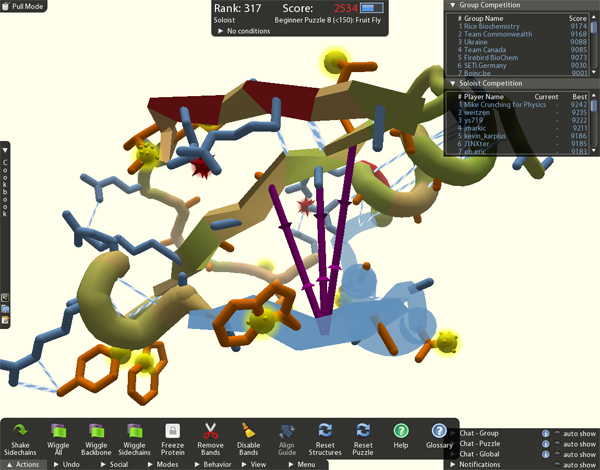
He shows me how to zoom and twist the protein around, how to put purple rubber band-like things onto various arms of it and pull it together or stretch it apart, how to change a loop to a helix to a sheet, and how to freeze one bit and tweak another. Hydrogen bonds, which look like blue-and-white barbershop poles, like to form between sheets and along helixes, he explains, showing me how to line them up.
Angry red bombs appear when things get squashed too tightly together – clashes. Big, pulsing red blobs appear when there’s too much empty space – voids. You want to avoid those. We fiddle with the side chains, rotating the orange ones in and the blue ones out. He even shows me how to “mutate” them.
The whole time, he’s keeping one eye on the score that’s evolving in the upper part of the screen. He makes a move that results in a huge loss of points; our score plunges into the negative numbers, turns red, and lots of red bombs appear. “Quick! Put it back!” I panic.
“Hang on,” he laughs. He’s totally relaxed. “Now we’re going to wiggle and shake.” He clicks a button and the whole structure starts bouncing, complete with a ticking soundtrack in the background. I watch as the points move rapidly upwards out of the red, then gradually slow down, while still increasing. After a while, Marcel clicks the wiggle off. Our total is higher than it was before! Then he clicks another button and all the side chains start rotating. Once again, the score ticks upwards. We sit back, satisfied.
The points represent energy, he explains. The native structure of the protein is going to be its lowest energy state. The higher the number of points, the lower the energy state. But like a ball on a golf course, you can get stuck in a local minimum and miss the hole you’re shooting for. “It’s like this building,” he says, looking at the undulating floor of the Learning Center. “A ball will roll down into a hole. But that doesn’t mean it’s the lowest hole around. It’s just the one it was nearest.” Sometimes you have to pull back quite a ways and shake things up to get the ball to roll into a deeper hole – a lower energy state.
When a protein is manufactured in the cell, it zips into this native shape in no time flat. The shape is critical to the protein’s function. Sometimes, if the environment isn’t right or there’s a problem with an accompanying protein, called a chaperone, the folding doesn’t go right. Misfolded proteins are implicated in a variety of diseases like mad cow, Alzheimer’s, Parkinson’s and cystic fibrosis.
Scientists would dearly like to be able to predict the structure of proteins, because then they could design drugs that could fix the misfolded ones, or disable the harmful ones in viruses or bacteria. With this kind of knowledge, perhaps some day new proteins could be engineered for gene therapy or other medical miracles.
Algorithms to predict structure chug along on huge servers or in distributed computing networks, like rosetta@home, which uses spare CPU on home computers to run its calculations, but they take forever because they have to brute force every conceivable possible convolution. There’s no guarantee the algorithm will find the lowest energy state, either, even after all that calculating. It’s a really complicated problem. FoldIt taps into something these algorithms cannot – human intuition and pattern-finding capabilities.
Marcel shows me the different puzzles available – they range in difficulty from easy structures put up for newbies like me to complex proteins involved in actual scientific research. There are only a few on at a time, each one with an open window of about a week, in which players work either on their own or in teams to get the highest possible points before it “closes.” You can “evolve” a protein, which means you work on a solution, and then share it with other people, who then add their bit to it, and so on. The protein’s structure then progresses as a joint effort. You have two rankings – “solo” and “team,” based on your results in each category. Marcel is a member of the Androids team.
He estimates that there are about 300 really active players, spread all over the world. The master solo player is a guy from Slovenia called Wudoo. A woman in Texas with a couple of kids, jpilkington, is the “evolver queen,” he tells me in reverent tones. While we’re playing, she comes online and starts chatting with other players. I tell her my brain is exploding. “LOL,” she replies.
Rav3n_pl, a programmer who lives in Poland, is a master at writing “scripts” –recipes that apply long strings of commands to the protein, which can be run in the background for hours while you’re off doing something else. Marcel started the flu design puzzle that morning. He first did a few manual tweaks, and then ran one of Rav3n_pl’s genetic algorithm scripts while he took a shower and ate breakfast. “The manual stuff can only take you so far,” he explains. After that, you eke out points at a time by running scripts. (These recipes, BTW, are the subject of a recent article in PNAS.)
As we continue to work the protein, I see what he means. The score appears to be stuck. “The deeper you are in an energy hole, the harder it is to move something,” he says. He opens the “cookbook” he has set up on the left hand side of the window and starts a script. We watch the protein jiggle and shake, the points fluctuating wildly as it starts, stops, reverts and starts another iteration.
Finding your way out of the hole is an art. There are a few people who are consistently among the top scorers, he tells me. “It’s not just luck. There’s something – either they have an intuitive feel for how the programming works, or they see patterns, or maybe they just have good computers and can run tons of scripts.”
Marcel has been away for a couple of weeks on military duty. Even so, his overall rank is 61. Wow, I say, you must play all the time!
“No, not more than an hour or two a day, max,” he assures me. “And a lot of that is just scripts running.” He admits, though, that when a deadline is approaching, he might put more time in with his team.
Well, sure, but you must also know a ton about molecular biology, in order to be able to rack up a ranking that high?
“Nope,” he says. “I just like getting the points. Sometimes you make a move, and you get a few points, and the protein just looks right, and it’s an amazing feeling.”
He also likes the social aspect of the game. “I’d never just play it offline,” he says. “I like chatting with my teammates. What should be the next step? What’s going on in their lives?” True. He is a chatty guy. He’s spending the entire afternoon with me, an uber-noob novelist, after all.
I figure he got into the game because he’s a chemistry student. “Not really,” he tells me. “At first, I looked into the seti@home thing, but then, really, who cares about aliens? I found rosetta@home, and that was cool, proteins are important, and it was there that I found out about FoldIt.”
Finally, we open the most recent puzzle on the site, something called a CASP roll, a “freestyle” protein with 197 amino acids that has to be folded from scratch. Sometime in February, the best FoldIt solutions will be compared with solutions cranked out by algorithms running on servers and with experimental data from x-ray crystallography and nuclear magnetic resonance imaging.
“Just look at that!” Marcel says as we contemplate the unfolded backbone stretching off into the screen. “197 amino acids! It’s huge!”
The CASPs are cutting edge science. A previous CASP puzzle solved by FoldIt gamers was published in Nature in September. Researchers had been struggling with an enzyme in a monkey version of the HIV virus. Despite the existence of several crystal forms of the protein, they were unable to solve its structure computationally, even though they’d been working on it for a decade. But if they could figure out its structure, they could engineer a way to disable it, thus hobbling the virus. They posed it as a FoldIt challenge, and within three weeks, two teams of FoldIt players (the Contenders and the Void Crushers) came up with multiple possibilities for its structure, enabling the scientists to further refine the game, which in turn led to the discovery of several molecular targets on the structure that can now be used to develop retroviral drugs.
As I drove Marcel back to the train station later that afternoon, I felt a little guilty. He’d spent his whole afternoon playing FoldIt with me, and his score hadn’t moved a whole lot. But then I remembered he had a two-hour train ride to Zurich, and a USB internet key.

On a walk along the lake the other day, I came across this set of footprints. Evidence that I am not alone. Continue reading
 Just as I walked up to the metro on Saturday, the doors shut in my face. I was literally one second too late.
Damn. Steamed. I’d been working in the Starbuck’s on the Place St. Francois for the last couple of hours. Yes, I know, Starbuck’s is a big, evil chain store that sells sub-par coffee for over-par prices and manipulates people with all kinds of marketing gimmicks. But it’s the only coffee shop I know of around here where I can get out of my head and into my writing properly. If I stay at home on the weekend I’m constantly being asked for food by the resident teenagers or feeling like I ought to be doing laundry, and I can’t get anything done.
See, in a place like Starbuck’s there are a lot of distractions. Babies crying, background music, other people working and talking, low lighting, lots of people coming and going. So many distractions, in fact, that I have no choice but to tune them all out and concentrate fully on the task at hand. And Starbuck’s, evil as it may be, does have one thing figured out: how to leave you alone and not make you feel guilty for taking up space. It’s like the Apple store I went to in Albuquerque, where the Japanese guy was just working away at one of the demo computers and nobody minded. I appreciate that.
Plus I secretly want to be J. K. Rowling.
I’ve always liked writing in the midst of chaos. In college, I wrote all my essays parked in a coffee shop near campus, drinking foamy lattes and eating chocolate chip cookies. Back then, in the dark ages, that meant writing by hand on a pad of paper, like in the picture at the top of the post. Now, with a laptop, it’s so much more efficient! As long as there’s a plug and tons of distractions, I can go into my zone. When I found out J. K. Rowling wrote Harry Potter in a coffee shop, it clicked. Someday I, too, would write a blockbuster in a coffee shop.
So there you have it, people. It’s finally happening.
Anyway, back to the metro. The monitor said the next one wouldn’t be there for 12 minutes, so I went into the news shop in the metro station and browsed the magazines. I took down the Economist, put it back. I can’t read it, it’s too dense and I object philosophically to the absence of bylines. Wired was really tempting. Then I caught a glimpse of the Technology Review hiding on a shelf behind. I pulled it out and looked at the cover.
Oh. My. God.
There on the cover of the Technology Review was a blurb that said Stem cells get personal. I may have mentioned that the novel I’m writing involves stem cells. I’d just had a bit of a block on the subject back in Starbuck’s, and I needed to do some research. I opened the article, and it was perfect. Exactly what I was looking for. How’s that for divine intervention?
I was so psyched that I went out for a run when I got home.
 I realize I have been remiss in reporting on my barefoot running adventure, so here’s an update for those of you who are interested: I haven’t put on a pair of regular running shoes since August. No kidding. I only wear my New Balances Minimus Trail shoes now. In fact, I wear them almost every time I leave the house for anything, I like them so much.
On Saturday, I don’t know whether it was the elation of having found the article on stem cells and unplugging the block in my writing, or the fact that there was a cushion of soft-looking fallen leaves on the ground, but I had a sudden urge to make skin-to-earth contact, and not with my face like I did last week, but with my feet. I took my shoes off and ran about 2 miles barefoot. The leaves took the worst of the bite out of the nasty little evil stones on the path. I ran along the beachfront in Preverenges, in and out of the water, feeling like a little kid. Then when I got back to the really evil section of path I photographed on my earlier post, I sat down by the lake and put the New Balances back on.
What a great run! A lot of people had given me strange looks, but I just smiled and carried on. My feet felt so happy.
I know you want to try barefoot running, too. In another astonishing stroke of serendipity, I ran across a how-to video this weekend so you can get started in the comfort of your own living room! In honor of the New York City Marathon, Christopher McDougall, of Born to Run fame, has an article in the NYT Magazine this Sunday. There’s a video of him hopping from one foot to the other, demonstrating how to work on your running form. If you don’t have a subscription to the online NYT, you can see the video at this blog, Hunter-Gatherer (written by a NYC barefoot runner type). Running barefoot may seem crazy, but trust me, it’s going mainstream. In a few years you’ll be thanking me for getting you started, because you will be so far ahead of all the other sad losers out there.
Images: top, StarbuckGuy. The other one is my foot.
Halloween has come and gone, hardly noticed here in chocolate land. Yesterday, the schoolkids traipsed by my house at lunch wearing normal clothing. It was so sad. Nobody got to wear a costume to school. (The Swiss don’t celebrate any holidays or birthdays at school, to be fair. School is for learning, not for partying.) Last night, despite my brimming basket of specially-purchased candy (I made an extra trip) we only had one group ring the doorbell. I even had a candle-filled pumpkin on the windowsill to beckon them in.
Maybe I got a bad reputation for what I did last year, when the village kids came trick-or-treating on October 30.
Come back tomorrow night, I’d said, genuinely shocked when they showed up at the door. I didn’t have any candy! (I can’t buy it more than one day in advance or I eat it all.) Today is not Halloween! The date is not negotiable!
Or maybe they remembered the year before, when I’d tried to explain Halloween etiquette. You have to say “trick or treat,” I instructed. I waited until they complied. And when you leave, you’re supposed to say “happy Halloween!”
In any case, it appears they’ve learned to avoid the snarky American lady with the ceramic pumpkin in the windowsill.
Never mind. More candy for me. Now it’s November, and as soon as I’ve saved my health by unloading the excess candy on my former office mates over at EPFL, I’m going to get down to business.

I’ve done a rash thing. I’ve signed up for National Novel Writing Month (NaNoWriMo). Although the name is misleading (it’s not limited to Americans or US residents), I think the overall idea is good. You’re supposed to crank out a novel in a month. You “win” if you manage to write 50,000 words. Nobody judges your work and there are no literary prizes involved. I love winning.
How hard can it be? I figure at 1,000 words a day, it’ll take me 50 days — oops. November only has 30 days. Recalibrate.
Hey, at 2,000 words a day, I’ll get five days off!
I already crank out nearly that in translations and blog posts every month. And I’m planning to refuse work for the next 30 days and hijack my blog, at least for a couple of posts, for excerpts from the developing novel.
Here’s the premise: Twenty-something writer in university communications office (gee, I wonder where I got that idea?) interviews highly reputed scientist professor x who is studying hot topic with big medical implications. Postdoc comes in during interview, meets writer, there’s chemistry. They start dating, writer discovers by accident that there might be more going on in professor x’s lab than meets the eye, and postdoc is not who he claims to be. Writer’s geek friend in the IT department (who is secretly in love with her) helps her uncover the secret using sophisticated hacking techniques and unsophisticated sneaky spying maneuvers. Things quickly get really weird and scary for writer who nonetheless saves the day (and keeps her job).
I just counted all those words – that’s 118 towards today’s total!
What do you think? Would you like me to post a few excerpts as I go? I might eventually put up the whole shebang on another part of my publishing empire site. Leave me a comment and let me know what you think.
I’m going to need help coming up with names, because I’m really terrible at that. I’ll need a name for the main character, for professor x, for the head of the communications office, for the geek in the IT department, and for the evil postdoc. (He has to be Swiss, though, keep that in mind.) The setting is in the US. I’m just not comfortable with all the language issues that I’d have to deal with if I set it here in Switzerland. If I pick a name you suggest, I’ll send you a free copy once the book is published! Hopefully this NaNoWriMo will get my butt in gear so it won’t be a decade before that happens…
While we’re on the topic of writing, I found a really cool website the other day, called Nieman Storyboard. It’s “a project of the nieman foundation for the study of journalism at harvard” (no caps) that basically deconstructs really good writing to see why it works so well. You get twice the bang for your buck: first, you find out about some really fantastic writing, and second, you find out why it’s such good writing. I’m hoping some of it will rub off on me.
David Dobbs’ deconstruction of Michael Lewis’ Vanity Fair article about the Greek Financial crisis knocked my socks off. I learned more from Lewis’ article than from all the newspaper stories I’ve read up to this point. It’s just so much more interesting to read what he writes. If you’re curious about the European debt crisis, read the Vanity fair article. If you’re interested in writing, read Dobbs on why it’s so great.
That should keep you busy for a while! I do promise, however, to write a post on junk DNA soon. I have some interesting stuff to share. And update you on my barefoot running progress (or lack thereof). Man, there aren’t enough hours in a day, even with daylight savings’ time…
Image: Marwa Morgan
I got the e-mail on Thursday. A translation for a client, due Monday. It was short and non-scientific, which can sometimes be a nice break. It’s good to diversify! I had a bunch of other stuff to finish up on Friday, but I said I’d do it over the weekend.
Saturday at 7:15 am, I’m in the car with Luc, headed to his school for the PSAT. We had discussed equipment the evening before. Two pencils, an eraser. A calculator, just in case. A pencil sharpener.
Last week, an article in the local paper caught my eye:
143 Mexican redknees looking for good homes.
Whoa. That’s a lot of tarantulas. But believe it or not, that was only the tip of the iceberg.
In late August, someone tried to enter Switzerland with a suitcase containing 260 live Mexican redknee tarantulas loosely packed in plastic bags. Authorities confiscated the tarantulas and split them up between three zoos in Switzerland, one of which was the Vivarium in Lausanne. The picture accompanying the article showed a pile of McDonald’s salad containers, each of which presumably contained a tarantula. Whoops, that’s not my salad! Continue reading
I just got back from running the Morat-Fribourg race – 17.17 km over bucolic Swiss countryside from the charming walled town of Morat (Murten in Swiss German) to Fribourg. The race has historical roots; it supposedly retraces the steps of a courier who was spreading the news that Charles the Bold had been defeated in a nearby battle. This was back in 1476. The runner carried a branch from a linden tree. Like so many runners to follow him, he collapsed on arrival. They planted a linden tree to mark the event.
I’m not going to get into Swiss history here because I would definitely be out of my depth. Who the heck was Charles the Bold and what was he doing in Switzerland? I’d just reveal my ignorance. (Wait, didn’t I just do that?) The race, however, is very popular. There are people who have run Morat-Fribourg every year without fail for most of their adult lives. This was number two for me.
The defining feature of this race is its altitude profile. (If you look at the link, notice all the first-aid stations…) It can be summed up in two words: bad-ass hills. The race finishes on a brutal uphill. This year I ran it in my New Balance minimalist trail shoes that have recently become my number-one preferred footwear. I was a little nervous about this because the race is run entirely on pavement. Up to now, most of my runs in the minimalist shoes have been at least partly on trails. (They’re trail shoes).
They were fine. Perfect. My feet feel great. My left calf muscle is a little sore, but it was 17.17 km, a lot of uphill. I suppose that’s to be expected. I’m sure a couple of beers and some chocolate will take care of it.
But that’s not the news. The news is that for the last 10k of the race, I ran alongside a woman who was wearing Tarahumara-style sandals!! Universes are truly aligning here. This cannot be a coincidence.
Let’s backtrack for a minute to the pre-race milling about in the starting area and the port-a-potty lines. I spent a lot of time looking at other people’s feet. NO ONE was wearing anything other than bonafide, cushioned, stablilized, run-of-the-mill running shoes. No one but me, that is. So imagine my surprise when a pair of huarache-type sandals edged into my peripheral vision on a hill at about 6 miles. WOW! She wasn’t wearing lycra, either. All of a sudden, the race got a lot more interesting.
We had the same basic pace, that is to say, strong on the ups and lame on the downs – without all that cushioning you don’t tend to overstride and slap your feet down so much doing downhill. Even though we were both running along in our own little zones, I loved every minute – I’d found a kindred spirit. Her form, which unfortunately I got a good look at as she pulled away from me on the last hill, was impeccable. I tried to imitate it, even as I was internally empathizing with the poor courier and his linden branch, and worrying about my own imminent collapse.
I didn’t collapse after all, and as I caught up with her in the finish chute I congratulated her on her footwear. She pointed mine out, too. She said she’d tried to find shoes like mine in Switzerland, unsuccessfully. I told her I’d gotten them in the US, and she raved about all the great possibilities in footwear that could be had across the pond. We basked for a moment in our mutual admiration. She asked me if I’d read Born to Run. Does the bear shit in the woods? Is the Pope Catholic? Then we went our separate ways.
The only other person I saw wearing anything alternative was a man walking barefoot across the finish line, way at the back of the pack. But he was carrying his shoes and his feet had some really nasty-looking blisters on them, so I don’t think the barefoot part had been planned ahead of time. He didn’t look too happy.
On a brief, last barefoot note – last week I walked barefoot all the way from the nasty gnarly trail I photographed for my barefoot blog post to our house the other day (maybe 2km). I just had a sudden desire to go barefoot. It was painful, but great. I like feeling the ground without an intermediary. One of the commenters on my Running and Rambling post obviously lives near me because he recommended a path that I know well. That’s my next step, to run/walk that trail barefoot. I’ve survived Morat-Fribourg, so I’ll do it next week and keep you posted!

Well, it happened! My piece about barefoot running has been posted on Running and Rambling! Go read it now! Comment on what a great post it is, and then please come back and read this account of my very first forays into running without shoes on. (There’s a link at the end of the post to redirect you to the journal here.)
For those of you who are coming from Running and Rambling, welcome. I hope you’ll stay around and read about stuff like crowdsourcing, the microbiome, how to kiss acquaintances in Switzerland and why Craig Venter is in trouble for quoting Proust in a junk portion of artificial DNA. I post new stuff twice a week, on average. It’s all over the map.
To get down to business, then: This is the trail I run on along Lake Geneva, the scene of the forays into barefooting recounted below. No cars, no glass, no snakes, no problem…
Week 1:
Tuesday: I decide to follow Donald’s wise example and take things very slowly. Heading past the friendly bodyguards staked out in front of the Chechnyan’s house, I run my usual 10k along the lake. I concentrate on bending my knees, as Barefoot Ken Bob suggests. On the way back, I take off my shoes and walk a 100m section of the gravel path. Sweet Jesus! How will I ever be able to run on this? I’m relieved there is no one witnessing my wincing, egret-like perambulation. Back home, I consult Ken Bob and discover that I should have kept my head up, not down, while walking. Clearly, this is going to take some time. The soles of my feet are about as resistant as the foam on my cappuccino.
Here’s a picture of just what I’m dealing with:

Friday: This time, I go back and forth on the same brutal stretch of gravel. Ken Bob says you have to start on the gnarliest bit of gravel you can find, otherwise you won’t get the form right, and you’ll get injured. Is it my imagination or does this hurt less than it did on Tuesday? I keep my head up. Damn, these little stones are sharp. I try to visualize the ball of my foot morphing to spread my weight over the stones. I imagine making little running steps but am not able to execute them. I am positive I’m going to puncture the sole of my foot. Every few meters I have to step off onto the grass for a break. Luckily there’s nobody around but an elderly couple, and they ignore me.
Week 2
Monday: Today, I remove my shoes 100m earlier. This section is not as gnarly, and I can get a little jog going in places. A bit of mud feels delicious squelching between my toes. I swear I can feel the ball of my foot adapting to the ground as it hits, and I concentrate on lifting my foot up instead of pushing off. Pretty soon I reach the nasty section, and sure enough the running gets too painful, and I have to walk. I focus on relaxing my shoulders and keeping my head up. It is an incredibly beautiful day, but no one is around to witness this. I find that oddly comforting.
Thursday: I’ve decided that Ken Bob is a sadist. I walk a longer section of the trail, gritting my teeth the entire time. This is definitely NOT fun. Sure, it’s easy for him to say – Go pick the gnarliest section of trail you can find, one that’s full of small, killer stones. He’s been going barefoot his whole life! He is not starting with cappuccino-foam feet! I fume as I walk along. There’s no way I can ever run barefoot on this stuff. There’s no way I’m ever going to get the form right if I can’t break into a jog! This is totally ridiculous. I head over to the lake and walk into the water. This is more like it. I run along the grass a bit, enjoying the feeling of the soft ground beneath my feet. I’m going to have to Skype my brother. We need to find some kind of middle ground here.
Friday: I share my barefoot experiences to date with my writing group. Incredulous, they suggest I update my tetanus immunization. Not a bad idea. I try to explain Ken Bob’s philosophy, that a piece of glass or the occasional nail is not really that big a deal in the grand scheme of a Barefoot Life. I decide to take my mini-Swiss Army knife with me on my runs, though, just in case I need the tweezers. Maybe I’ll also go ahead and start transitioning to the New Balances, because if I continue breaking my feet in at this rate, it’ll be January before I can actually run for any appreciable distance. And no matter what Ken Bob says, frozen feet are not on my list of must-have life experiences.

Saturday: We went hiking on a beautiful trail, and I kept thinking how great it would be to run it in my New Balances.
Week 3
Tuesday: I run five miles in the New Balances. I bend my knees, gliding Zen-like across the ground, slowly. Later I return to the scene of my barefooting to take some pictures, and I make another attempt at walking along the path. It looks so smooth from a distance! But each step is a little world of torture. Makes you think twice about that expression, A walk in the park. Not obvious. Not obvious at all. It’s a function of your footwear and the surface roughness of the park.
Thursday, Friday, Saturday, Sunday: I’m in Holland, where I run a few kilometers every day in the New Balances. My foot is fine! I’m bending my knees like Ken Bob says, keeping weight under my body. Holland is flat. Really, seriously flat, except for the occasional slight rise to get up onto the dikes. It’s also exactly, or even slightly lower than, sea-level, so no excuses. And because it’s really cold here and the only other shoes I brought are sandals, I’ve been doing all my walking around in the New Balances as well. I really like these shoes! I may never take them off!
Bonjour! (Kiss, kiss, kiss)*
Hey! (hug)
Hello. Nice to meet you. (right hand extended, waist level)
* language and number of kisses may vary
These appear to be the accepted Western greeting rituals. But which to use? With whom? When? And how are they properly executed? It’s no big deal until you screw it up. One moment is all it takes to go from potentially interesting person to totally awkward inept proto-caveman. That first impression is everything, right?
As an expat, this issue comes up frequently. Continue reading